DEXs without document upload: wallet access, swaps and trading fees
Some decentralized trading flows start with a wallet connection instead of an identity-document upload. Compare swaps, perpetuals and trading terminals by the task you need, the entry process and the final cost.
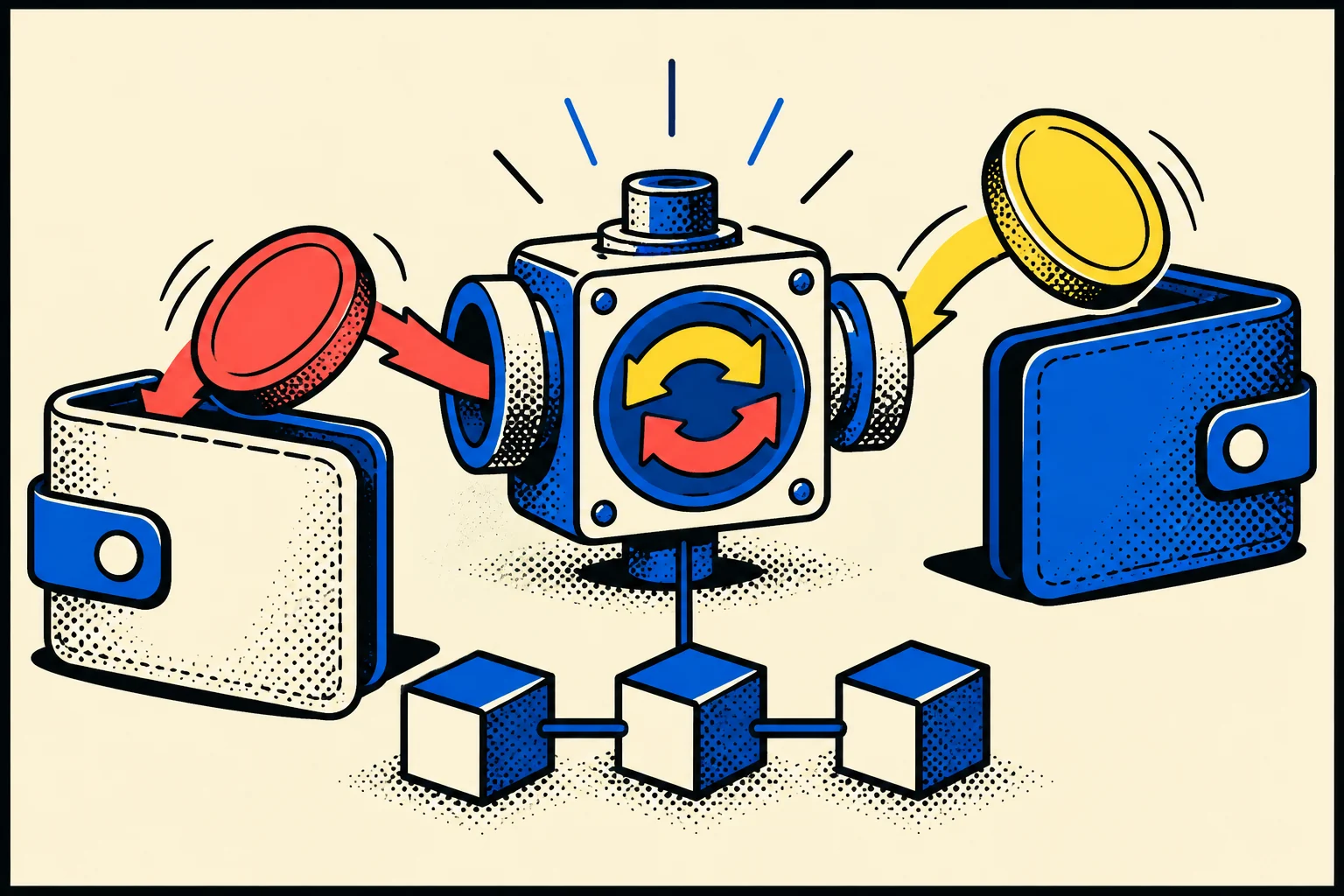
No KYC means no identity-document submission
KYC is identity verification using documents such as an ID card. Some wallet trading routes do not require those documents. Wallet transactions can still be public, and country restrictions remain.
Compare platforms ↓Identity checks and privacy
Public blockchains expose wallet addresses and transaction histories. Trading interfaces may also screen addresses. Uniswap documents its screening process.
Perpetuals, swaps and terminals
| Product | Purpose |
|---|---|
| Perpetual | Contract on price changes, with margin, funding and possible liquidation |
| Swap | Exchange of one token for another |
| Terminal | Software for analysis and sending trades to markets |
The decentralized futures article explains margin and leverage.
How token conversion works
A swap pays one asset and receives another. Output depends on price, liquidity and route costs. Cross-chain conversion may use a bridge or liquidity provider.
Axiom and GMGN also provide analytics and wallet tracking. Their terminal accounts and fees are separate from the underlying swap protocol.
Transparency compared with brokers and small CEXs
Public contracts and transactions make settlement visible. This offers more transparency than a broker with unclear pricing or a small exchange with uncertain withdrawals. A non-custodial model reduces reliance on a company’s internal ledger.
Company risk can give way to smart-contract, price-feed or bridge risk. The word “decentralized” alone does not establish execution quality or security.
Fees and final swap output
| Cost | Plain meaning |
|---|---|
| Trading fee | Charge for opening, closing or swapping |
| Funding | Periodic payment between the two sides of a perpetual market; it can be received |
| Gas and transfers | Cost of recording a transaction or moving assets between chains |
| Price impact and slippage | Price changes caused by order size, or the difference between quoted and executed prices |
A lower trading fee does not always produce more tokens. Thin liquidity and network charges can reduce the final output.
Risks by product
Leverage magnifies price losses relative to collateral. Thin liquidity and counterfeit tokens can cause swap losses. Contract bugs, bridges and malicious wallet permissions create separate risks.
How to enter a platform
Use the platform’s entry button in the comparison table. For a swap, choose the sending and receiving networks and assets. For a perpetual, select a market, collateral amount and order type.
If a page does not load, check the connection and browser. A VPN can change the connection route; the platform’s country support and account requirements still apply.
Platforms: futures first, then swaps
Wallet onboarding, geographic eligibility and fiat-provider checks are separate questions.
| Platform | Use case | Access and KYC | Open platform |
|---|---|---|---|
| Futures & perpetuals | |||
| Perpetual derivatives | Trading fees and funding are separate | Open platform | |
 Hyperliquid | Order-book perpetuals | Wallet or email onboarding | Open platform |
 Veranta (Avantis) | On-chain derivatives | Card-provider KYC varies | Open platform |
 ApeX | ApeX Omni perpetuals | No-KYC trading, per official update | Open platform |
 Lighter | Order-book perpetuals | Depends on account and order type | Open platform |
 GMX | Oracle-priced perpetuals | Wallet-based trading | Open platform |
| Token swaps & conversion | |||
 NEAR | Cross-chain swaps | Interface and route terms apply | Open platform |
 Uniswap | Token swaps | Fiat purchase can require KYC | Open platform |
 PancakeSwap | Token swaps | Wallet connection | Open platform |
 1inch | Swap aggregation | Screening and access limits | Open platform |
 DeFiLlama Swap | Swap-route comparison | Underlying route terms apply | Open platform |
 Jupiter | Solana ecosystem swaps | Product-specific conditions | Open platform |
 Raydium | Solana swaps and liquidity | Wallet interaction | Open platform |
| On-chain trading terminals | |||
 Axiom | On-chain trading terminal | Terminal account and access | Start Axiom with signup benefits |
 GMGN | Token analytics and trading terminal | Account and product terms | Open platform |
Platform summaries
Futures & perpetuals
Aster
Open platformAster offers perpetual and spot trading with wallet or email access. Market and limit orders provide different execution methods.
- Main use
- Derivatives, margin and funding
- Costs and conditions
- The market and order type determine the applicable trading charge.
Hyperliquid
Open platformHyperliquid documents wallet and email onboarding. Its perpetual contracts are distinct from token swaps.
- Main use
- No-expiry contracts and collateral
- Costs and conditions
- Trading fees and funding are separate charges.
Veranta (Avantis)
Open platformAvantis rebranded to Veranta in September 2026. Avantis documents wallet access. Its card on-ramp has provider-dependent identity checks.
- Main use
- Crypto collateral; separate fiat on-ramp
- Costs and conditions
- Card purchases have separate fees and conditions.
ApeX
Open platformApeX’s 26 October 2026 update describes non-custodial wallet trading without KYC. Fiat purchase services have separate requirements.
- Main use
- Perpetual markets and wallet signatures
- Costs and conditions
- Regional conditions and charges depend on the product.
Lighter
Open platformLighter is an order-book perpetual market with verifiable execution. The trading screen brings together price, order size and collateral.
- Main use
- Order book and verifiable execution
- Costs and conditions
- Charges follow the applicable account and market schedule.
GMX documents wallet-based trading and oracle pricing. Card funding and bridging are separate flows.
- Main use
- Flexible collateral and derivatives
- Costs and conditions
- Funding, borrowing and price impact can add to trading fees.
Token swaps & conversion
NEAR
Open platformNEAR Intents supports cross-chain quotes, execution and status tracking. Source and destination networks are part of the trade.
- Main use
- Cross-chain conversion
- Costs and conditions
- Each quote has an output amount and an expiry time.
Uniswap
Open platformUniswap supports wallet token swaps. Its help centre states that third-party fiat purchases require KYC.
- Main use
- Wallet swaps; separate fiat purchase
- Costs and conditions
- The final cost includes swap and network fees.
PancakeSwap
Open platformPancakeSwap’s swap flow connects a wallet, selects tokens and confirms a quote. This is not a domestic fiat purchase.
- Main use
- Token conversion and routing
- Costs and conditions
- Output depends on the network, token and pool liquidity.
1inch
Open platform1inch offers swap routing and cross-chain conversion. Its site also describes wallet screening and access restrictions.
- Main use
- Routing and cross-chain swaps
- Costs and conditions
- Wallet screening forms part of the access conditions.
DeFiLlama Swap
Open platformDeFiLlama Swap compares swap-aggregator quotes. Different routes can use different services.
- Main use
- Compare swap-route outputs
- Costs and conditions
- Net output reflects route and network costs.
Jupiter
Open platformJupiter has multiple products. This listing refers to token swaps; its perpetual and other services have separate terms.
- Main use
- Token swaps and output preview
- Costs and conditions
- Swaps and perpetuals are separate products.
Raydium
Open platformRaydium provides Solana swaps and liquidity pools. A pool listing does not validate its token project.
- Main use
- Liquidity-pool swaps
- Costs and conditions
- Pool depth affects the swap execution price.
On-chain trading terminals
Axiom is a hybrid terminal for token trading, wallet tracking and analysis. It is distinct from a basic swap protocol or a futures account.
- Main use
- Token trading and wallet analytics
- Costs and conditions
- Accounts, trading permissions and terminal fees have separate conditions.
GMGN
Open platformGMGN combines token analytics, wallet tracking and trading. Copy trading and on-chain metrics do not guarantee returns or token quality.
- Main use
- Token analytics, tracking and trading
- Costs and conditions
- Terminal fees add to network and trading costs.
Frequently asked questions
Which futures platforms are included?
Aster, Hyperliquid, Veranta (Avantis), ApeX, Lighter and GMX, each with separate access conditions.
Does no KYC mean access from Iran is allowed?
No. Aster explicitly restricts Iran in its official terms. Each platform has its own conditions.
Do I need futures to swap tokens?
No. A token swap exchanges assets; a perpetual is a derivative with funding and liquidation mechanics.
Are no-KYC futures risk free?
No. Leverage, liquidation, smart contracts, collateral and access restrictions still matter.
Can card purchases require KYC?
Yes. A fiat payment provider can require verification independently of wallet trading.
Are all on-chain products fully non-custodial?
No. Swap protocols, terminals, embedded wallets and derivatives markets have different custody and control models.