DEX trading guide: choosing a platform, connecting a wallet and fees
Choose a swap to exchange tokens or a perpetual market to trade price changes. This guide compares the platforms for each task and explains wallet connection, order types and transaction costs.
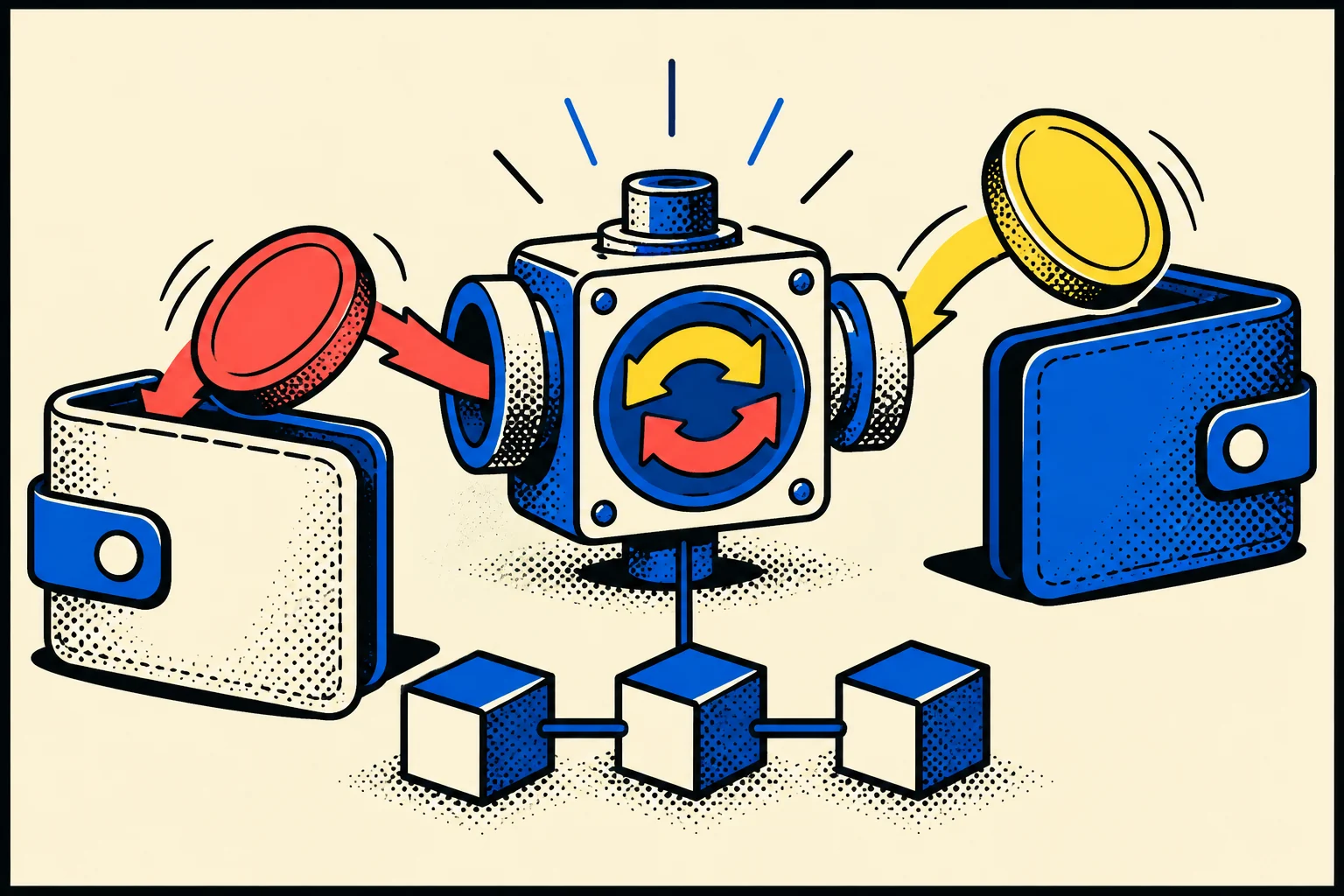
DEX stands for decentralized exchange
Blockchain contracts and transactions perform part of trade execution or settlement. Many services use wallet access. The onboarding method, trading product and identity conditions are separate questions.
Platform comparison ↓How decentralized trading works
In a common swap model, a wallet signs a trade transaction and a smart contract records the asset exchange. A smart contract is a program that executes rules on a blockchain. The website is software for viewing quotes and submitting requests.
A protocol and an interface are distinct layers. Uniswap’s DeFi explanation distinguishes its protocol from interface products. Contract control, key custody and operator roles vary by service.
Decentralized and centralized exchange models
| Topic | Centralized exchange | Non-custodial DEX model |
|---|---|---|
| Balance record | Service’s internal account | Wallet or trading contract |
| Authorization | Account instruction | Wallet signature or recorded permission |
| Settlement | Much activity is internal | Contract execution or settlement is on-chain |
| Risk sources | Including company operations and custody | Including contracts, permissions and liquidity |
A hybrid product can combine centralized and on-chain components. The DEX label does not establish equal user control across every service.
Spot, swaps, futures and perpetuals
| Product | Result |
|---|---|
| Spot | Buying or selling the asset itself |
| Swap | Exchanging one asset for another |
| Dated futures | Price contract with an expiry date |
| Perpetual or perp | Price contract without a fixed expiry |
Spot and swaps can deliver tokens. A perpetual creates price exposure supported by collateral. Funding is a periodic payment associated with that market. Hyperliquid’s contract specifications provide an official example.
Decentralized futures and perpetual platforms
Aster, Hyperliquid, Veranta (Avantis), ApeX, Lighter and GMX form the perpetual group in this article. Execution models differ. Some use order books; others use oracle reference prices.
An oracle supplies price data to a contract. GMX documents oracle-based pricing. A long gains from rising prices and a short from falling prices; adverse moves cause losses. Leverage increases position value relative to collateral.
The decentralized futures article explains collateral and holding costs.
View ApeXSwaps and cross-chain conversion
A swap exchanges an input asset for an output asset. Pool balances or liquidity-provider quotes affect execution. Liquidity is the asset supply available for trading; limited liquidity can increase price differences.
Uniswap, PancakeSwap and Jupiter’s swap product exchange tokens. NEAR Intents supports conversion across supported networks. Source and destination chains are part of the order; token support alone does not guarantee every quote.
View NEAR swapsWhat trading without identity documents means
KYC verifies identity using documents such as an ID card. Some services begin trading through wallet access without those documents. Public blockchains can still expose wallet transactions; document-free onboarding is distinct from anonymity.
Card funding, country eligibility and wallet trading can have separate conditions. ApeX’s update describes no-KYC trading. Aster’s terms reserve checks and restrict Iran. Decentralized exchange is not a uniform eligibility policy.
The components of a DEX trade’s cost
| Item | Meaning |
|---|---|
| Trading charge | Swap service or position entry and exit |
| Gas and transfers | Blockchain execution and asset movement |
| Price impact and slippage | Order-driven price changes or expected-versus-executed differences |
| Funding and borrowing | Periodic charges or receipts in some derivatives markets |
Illustrative arithmetic: a hypothetical 0.3% fee on $100 is $0.30. With a hypothetical $1 network cost, those two components total $1.30 before execution-price differences. These numbers are not a platform tariff.
Axiom and GMGN in on-chain trading
A terminal combines token analysis, wallet activity and order submission. Axiom and GMGN provide such tools. Displaying on-chain data or another address’s transaction does not itself create a matching trade in another account.
Tracking observes activity; copy trading creates orders based on another account. Terminal access and charges are separate from the underlying swap protocol. The Axiom fee article and GMGN overview explain these layers.
Start Axiom with signup benefitsHow to enter a platform
Use the platform’s entry button in the comparison table. For a swap, choose the sending and receiving networks and assets. For a perpetual, select a market, collateral amount and order type.
If a page does not load, check the connection and browser. A VPN can change the connection route; the platform’s country support and account requirements still apply.
Futures, perpetual and swap platforms
Futures and perpetuals appear first, followed by swaps and terminals. The order is not a ranking of returns, safety or access eligibility.
| Platform | Trading product | Access and KYC | View platform |
|---|---|---|---|
| Futures & perpetuals | |||
| Perpetual derivatives | Trading fees and funding are separate | View Aster | |
 Hyperliquid | Order-book perpetuals | Wallet or email onboarding | View platform |
 Veranta (Avantis) | On-chain derivatives | Card-provider KYC varies | View platform |
 ApeX | ApeX Omni perpetuals | No-KYC trading, per official update | View ApeX |
 Lighter | Order-book perpetuals | Depends on account and order type | View platform |
 GMX | Oracle-priced perpetuals | Wallet-based trading | View platform |
| Token swaps & conversion | |||
 NEAR | Cross-chain swaps | Interface and route terms apply | View NEAR swaps |
 Uniswap | Token swaps | Fiat purchase can require KYC | View platform |
 PancakeSwap | Token swaps | Wallet connection | View platform |
 Jupiter | Solana ecosystem swaps | Product-specific conditions | View platform |
| On-chain trading terminals | |||
 Axiom | On-chain trading terminal | Terminal account and access | Start Axiom with signup benefits |
 GMGN | Token analytics and trading terminal | Account and product terms | View GMGN |
Decentralized platforms and trading tools
Futures & perpetuals
Aster
View AsterAster offers perpetual and spot trading with wallet or email access. Market and limit orders provide different execution methods.
- Purpose
- Derivatives, margin and funding
- Costs and conditions
- The market and order type determine the applicable trading charge.
Hyperliquid
View platformHyperliquid documents wallet and email onboarding. Its perpetual contracts are distinct from token swaps.
- Purpose
- No-expiry contracts and collateral
- Costs and conditions
- Trading fees and funding are separate charges.
Veranta (Avantis)
View platformAvantis rebranded to Veranta in September 2026. Avantis documents wallet access. Its card on-ramp has provider-dependent identity checks.
- Purpose
- Crypto collateral; separate fiat on-ramp
- Costs and conditions
- Card purchases have separate fees and conditions.
ApeX
View ApeXApeX’s 26 October 2026 update describes non-custodial wallet trading without KYC. Fiat purchase services have separate requirements.
- Purpose
- Perpetual markets and wallet signatures
- Costs and conditions
- Regional conditions and charges depend on the product.
Lighter
View platformLighter is an order-book perpetual market with verifiable execution. The trading screen brings together price, order size and collateral.
- Purpose
- Order book and verifiable execution
- Costs and conditions
- Charges follow the applicable account and market schedule.
GMX documents wallet-based trading and oracle pricing. Card funding and bridging are separate flows.
- Purpose
- Flexible collateral and derivatives
- Costs and conditions
- Funding, borrowing and price impact can add to trading fees.
Token swaps & conversion
NEAR
View NEAR swapsNEAR Intents supports cross-chain quotes, execution and status tracking. Source and destination networks are part of the trade.
- Purpose
- Cross-chain conversion
- Costs and conditions
- Each quote has an output amount and an expiry time.
Uniswap
View platformUniswap supports wallet token swaps. Its help centre states that third-party fiat purchases require KYC.
- Purpose
- Wallet swaps; separate fiat purchase
- Costs and conditions
- The final cost includes swap and network fees.
PancakeSwap
View platformPancakeSwap’s swap flow connects a wallet, selects tokens and confirms a quote. This is not a domestic fiat purchase.
- Purpose
- Token conversion and routing
- Costs and conditions
- Output depends on the network, token and pool liquidity.
Jupiter
View platformJupiter has multiple products. This listing refers to token swaps; its perpetual and other services have separate terms.
- Purpose
- Token swaps and output preview
- Costs and conditions
- Swaps and perpetuals are separate products.
On-chain trading terminals
Axiom is a hybrid terminal for token trading, wallet tracking and analysis. It is distinct from a basic swap protocol or a futures account.
- Purpose
- Token trading and wallet analytics
- Costs and conditions
- Accounts, trading permissions and terminal fees have separate conditions.
GMGN
View GMGNGMGN combines token analytics, wallet tracking and trading. Copy trading and on-chain metrics do not guarantee returns or token quality.
- Purpose
- Token analytics, tracking and trading
- Costs and conditions
- Terminal fees add to network and trading costs.
Common DEX trading questions
What is DEX trading?
It is cryptocurrency trading through decentralized markets, including token swaps and contracts on price changes.
Does every DEX offer no-KYC trading?
No. Onboarding, country conditions and identity checks differ between services.
Are swaps and perpetuals the same?
No. A swap exchanges assets; a perpetual is a price contract without a fixed expiry.
Does all crypto trading use leverage?
No. A spot purchase or simple swap does not itself create a leveraged position.
How do dated futures differ from perpetuals?
Traditional futures have an expiry date. Perpetuals have no fixed expiry and generally use funding.
Does wallet access permit trading from Iran?
No. Each service has separate conditions. Aster explicitly lists Iran as a prohibited jurisdiction.
Can a DEX trade incur gas fees?
Yes. Recording a blockchain transaction can incur network costs separate from platform charges.
Is a terminal the swap protocol itself?
No. A terminal provides analysis and order submission and can use other markets or protocols.