Decentralized futures guide: wallet access, leverage, funding and fees
Use collateral to open a long or short position on a decentralized perpetual market. Compare platforms and learn how leverage, trading fees, funding and liquidation affect an order, with a worked example.
What does no-KYC futures trading mean?
Some platforms begin trading through a wallet connection without identity documents. This onboarding method does not remove country restrictions or card-provider checks.
Compare platforms ↓Perpetuals in plain language
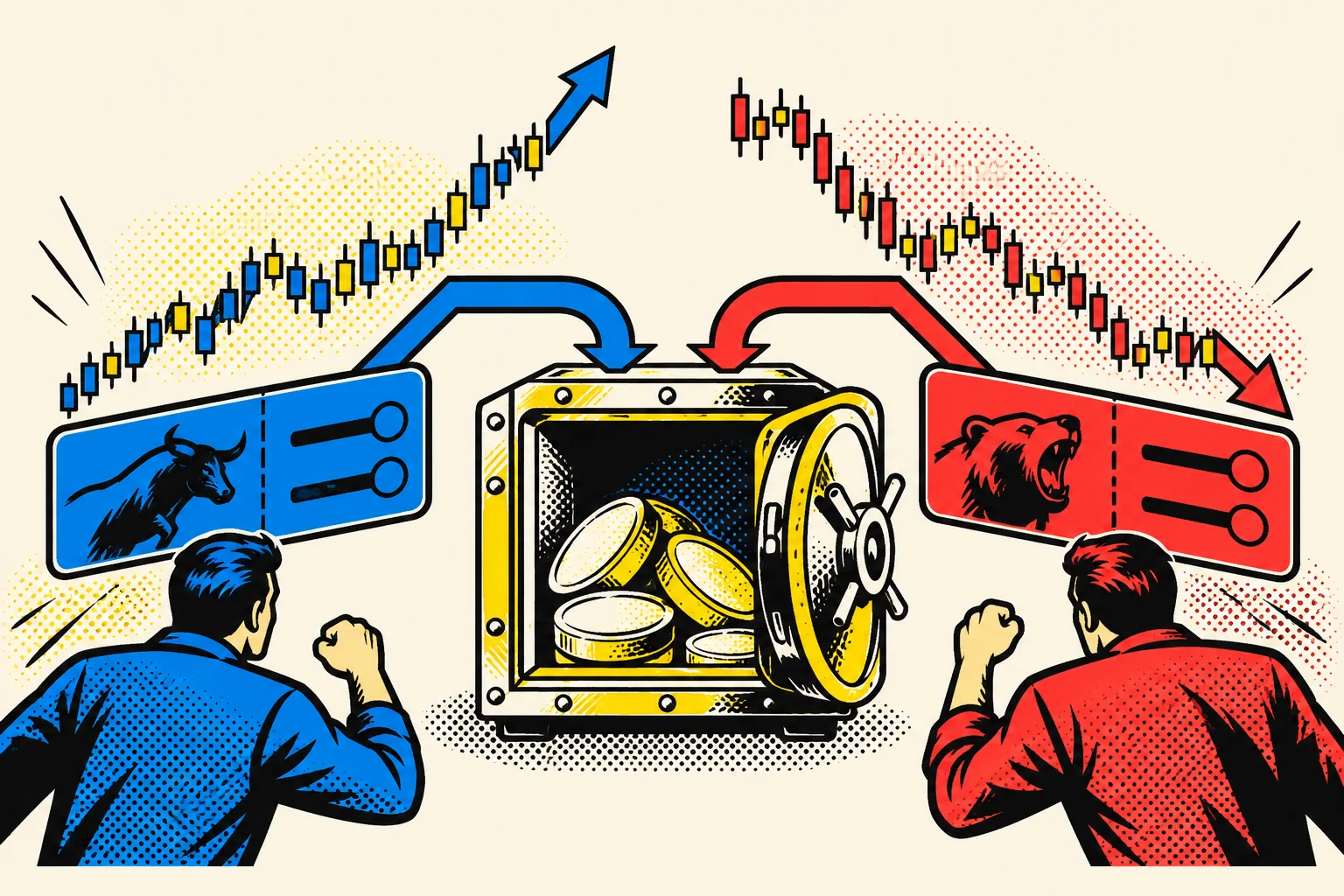
Traditional futures have an expiry date. Perpetuals have no fixed expiry. Their profit or loss follows price movements; holding the contract does not deliver the underlying coin.
| Term | Meaning |
|---|---|
| Long | Gains from a price rise and loses from a fall |
| Short | Gains from a price fall and loses from a rise |
| Margin | Collateral supporting the position |
| Liquidation | Forced closure when collateral is insufficient |
Leverage with numbers
$100 of collateral at 10x leverage supports a $1,000 position. A 1% price move produces $10 of profit or loss before costs, equal to 10% of the collateral.
| Item | Amount |
|---|---|
| Collateral | $100 |
| Leverage | 10x |
| Position value | $1,000 |
| A 1% price move | $10 profit or loss |
The liquidation price depends on margin rules and costs. Isolated margin belongs to one position; cross margin shares a balance across positions.
What makes up a perpetual’s cost?
| Cost | Plain meaning |
|---|---|
| Trading fee | Charge for opening, closing or swapping |
| Funding | Periodic payment between the two sides of a perpetual market; it can be received |
| Gas and transfers | Cost of recording a transaction or moving assets between chains |
| Price impact and slippage | Price changes caused by order size, or the difference between quoted and executed prices |
Some models also charge borrowing fees. Time in the position affects the total of recurring charges.
Brokers and centralized exchanges
Public contracts and transactions make settlement visible. This offers more transparency than a broker with unclear pricing or a small exchange with uncertain withdrawals. A non-custodial model reduces reliance on a company’s internal ledger.
Company risk can give way to smart-contract, price-feed or bridge risk. The word “decentralized” alone does not establish execution quality or security.
Wallet access and identity checks
Wallet connection, card purchases and country eligibility are separate conditions. A payment provider can require documents even when trading begins through a wallet.
Perpetuals and token conversion
A perpetual trades price exposure. A swap exchanges actual assets. The decentralized exchange and swap article explains the difference.
How to enter a platform
Use the platform’s entry button in the comparison table. For a swap, choose the sending and receiving networks and assets. For a perpetual, select a market, collateral amount and order type.
If a page does not load, check the connection and browser. A VPN can change the connection route; the platform’s country support and account requirements still apply.
Compare futures and perpetual platforms
These are the six platforms from the homepage’s perpetual category, each with independent access and account terms.
| Platform | Trading model | Access and KYC | Open platform |
|---|---|---|---|
| Futures & perpetuals | |||
| Perpetual derivatives | Trading fees and funding are separate | Open platform | |
 Hyperliquid | Order-book perpetuals | Wallet or email onboarding | Open platform |
 Veranta (Avantis) | On-chain derivatives | Card-provider KYC varies | Open platform |
 ApeX | ApeX Omni perpetuals | No-KYC trading, per official update | Open platform |
 Lighter | Order-book perpetuals | Depends on account and order type | Open platform |
 GMX | Oracle-priced perpetuals | Wallet-based trading | Open platform |
Platform summaries
Futures & perpetuals
Aster
Open platformAster offers perpetual and spot trading with wallet or email access. Market and limit orders provide different execution methods.
- Product model
- Derivatives, margin and funding
- Costs and conditions
- The market and order type determine the applicable trading charge.
Hyperliquid
Open platformHyperliquid documents wallet and email onboarding. Its perpetual contracts are distinct from token swaps.
- Product model
- No-expiry contracts and collateral
- Costs and conditions
- Trading fees and funding are separate charges.
Veranta (Avantis)
Open platformAvantis rebranded to Veranta in September 2026. Avantis documents wallet access. Its card on-ramp has provider-dependent identity checks.
- Product model
- Crypto collateral; separate fiat on-ramp
- Costs and conditions
- Card purchases have separate fees and conditions.
ApeX
Open platformApeX’s 26 October 2026 update describes non-custodial wallet trading without KYC. Fiat purchase services have separate requirements.
- Product model
- Perpetual markets and wallet signatures
- Costs and conditions
- Regional conditions and charges depend on the product.
Lighter
Open platformLighter is an order-book perpetual market with verifiable execution. The trading screen brings together price, order size and collateral.
- Product model
- Order book and verifiable execution
- Costs and conditions
- Charges follow the applicable account and market schedule.
GMX documents wallet-based trading and oracle pricing. Card funding and bridging are separate flows.
- Product model
- Flexible collateral and derivatives
- Costs and conditions
- Funding, borrowing and price impact can add to trading fees.
No-KYC futures questions
What is a no-KYC decentralized futures exchange?
It is a derivatives venue with a trading route that may begin through a wallet without conventional identity documents. Eligibility and third-party services have separate conditions.
Are futures and perpetuals identical?
Traditional futures have an expiry date. Perpetuals have no fixed expiry and generally use funding.
Which homepage platforms are included?
Aster, Hyperliquid, Veranta (Avantis), ApeX, Lighter and GMX, with individual notes on access and costs.
Does no KYC guarantee unrestricted withdrawals?
No. Contract rules, open-position collateral, interface terms and legal or service restrictions can affect access and withdrawals.
Does higher leverage make a platform better?
No. Execution, liquidity, costs and collateral management matter. More leverage makes collateral more sensitive to price moves.
Are these always better than brokers or centralized exchanges?
Advantages depend on the criterion. Transparent and non-custodial models can reduce company dependence while introducing contract, oracle, bridge and leverage risks.